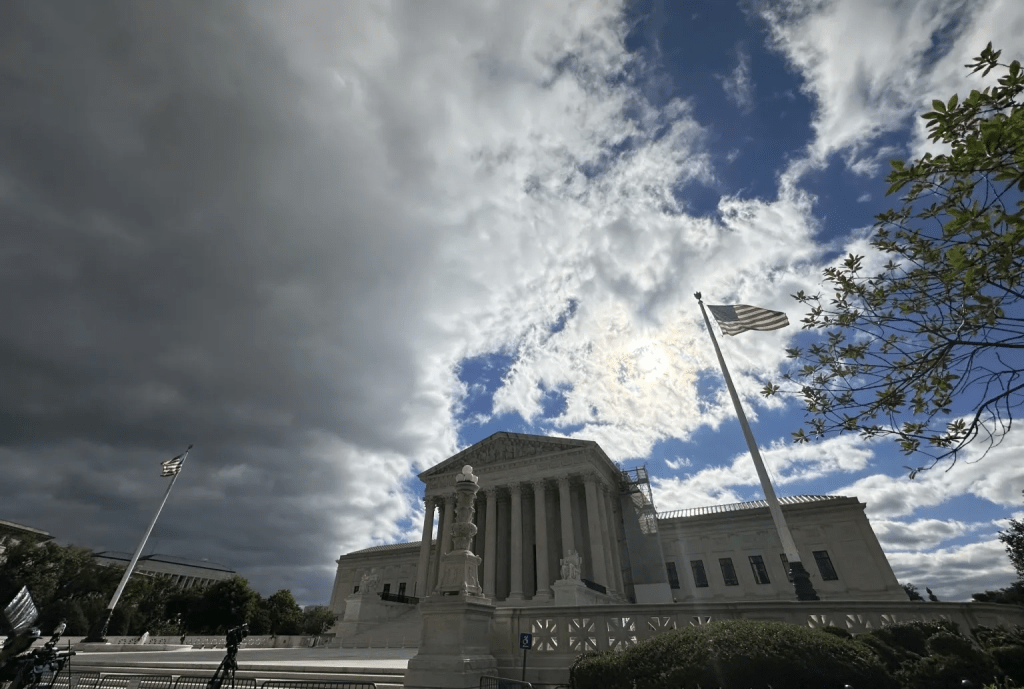
The Supreme Court has added four compelling cases to its 2025–26 term docket, covering a wide range of legal themes—intellectual disability and the death penalty, criminal sentencing, post-conviction relief, and civil procedure. These cases are set to shape important federal doctrines while stirring debate among legal scholars, practitioners, and policymakers alike.
A Procedural Mishap and a Friday Night Surprise
In an unusual move, the Court released its new docket additions on Friday evening—an early release prompted by a technical glitch. Email notifications about orders were inadvertently sent to attorneys before the official release, leading the Court to drop the entire list ahead of its Monday schedule.
The cases chosen span high-stakes criminal and procedural issues, reflecting the Court’s continuous involvement in refining the balance between individual rights, federal power, and due process.
⚖️ Case 1: Alabama v. Smith – Death Penalty & Intellectual Disability
🔹 Issue: How courts should evaluate multiple IQ scores when determining if a death row inmate is intellectually disabled under the Eighth Amendment.
The most headline-grabbing case involves Joseph Smith, an Alabama death row inmate convicted for the murder of Durk Van Dam. The central issue is whether Smith’s execution violates the Eighth Amendment’s prohibition on cruel and unusual punishment due to claims of intellectual disability.
After years of deliberation—22 Supreme Court conferences to be exact—the justices previously sent the case back to the U.S. Court of Appeals for the 11th Circuit for clarification. That court reiterated its stance: Smith’s condition, when examined in totality (including expert testimony), justifies setting aside the death sentence.
Now the Supreme Court has agreed to directly weigh in, particularly on how courts may assess the cumulative effect of multiple IQ scores in determining intellectual disability. Alabama argues that this process is “complicated” and lacks clear direction from the Supreme Court.
This case revisits precedents like Atkins v. Virginia (2002), which barred the execution of intellectually disabled defendants but left courts with little guidance on interpreting complex psychological assessments.
⚖️ Case 2 & 3: Rutherford v. U.S. & Carter v. U.S. – Sentence Reductions and Non-Retroactive Law
🔹 Issue: Whether federal judges can consider non-retroactive changes in criminal law as “extraordinary and compelling reasons” to reduce sentences under 18 U.S.C. § 3582(c)(1)(A).
These two cases, which will be argued together, probe the limits of compassionate release in light of changes in sentencing laws. Petitioners argue that even if a change in law isn’t retroactive, it may still justify a sentence reduction due to the unjust disparity it creates.
Lower courts are split. Some believe judges should be permitted to evaluate the fairness of continued incarceration based on such legal changes, while others argue that doing so defies Congressional intent and undermines finality in sentencing.
The Court’s decision will likely reshape how federal inmates pursue compassionate release and clarify judicial discretion in post-sentencing reviews.
⚖️ Case 4: Coney Island Auto Parts v. Burton – Civil Procedure Default Judgments
🔹 Issue: Does Federal Rule of Civil Procedure 60(c)(1) impose a time limit to set aside a default judgment void for lack of personal jurisdiction?
In this civil procedure case, the justices will address whether time limitations apply when a default judgment is challenged on jurisdictional grounds.
Typically, FRCP 60(c)(1) requires motions to set aside judgments to be made “within a reasonable time,” with certain grounds capped at one year. But a judgment rendered without personal jurisdiction is considered void—raising the question: Can such a void judgment be challenged at any time?
This case will have practical implications for businesses and individuals who discover years later that judgments were entered against them improperly.
🛑 Denied Petitions: Ayers, Voting, and Gun Laws
🔹 Karla Ayers: A Denied Appeal With a Warning
The Court declined to hear Ohio’s appeal in Ayers v. Ohio, where Karla Ayers, convicted of arson and child endangerment, sought post-conviction relief years after trial. Her case gained traction after a new fire expert, hired by the Ohio Innocence Project, undermined the original forensic testimony.
The 6th Circuit ruled that Ayers’s claim could proceed despite the expiration of the federal statute of limitations, citing newly discovered evidence. The Supreme Court denied Ohio’s appeal, but Justice Alito warned that this should not be interpreted as endorsing the lower court’s legal reasoning.
This decision underscores the tension between strict procedural rules and substantive justice in post-conviction litigation.
🔹 Other Denials: Election Integrity and Gun Control
- RNC v. Pennsylvania: The Court declined to review a Pennsylvania ruling allowing provisional ballots from voters whose mail ballots were invalidated.
- Challenge to D.C.’s Ban on High-Capacity Magazines: A gun rights case was also left off the docket, signaling the Court’s selective approach to Second Amendment cases for now.
🔍 Takeaways for Lawyers and Legal Scholars
- Criminal defense attorneys should monitor Smith and Rutherford/Carter closely for guidance on capital litigation and compassionate release.
- Civil litigators will find Coney Island Auto Parts relevant for long-settled judgments involving jurisdictional flaws.
- Post-conviction advocates will see Ayers as a cautionary tale about the hurdles and hope in wrongful conviction cases.
#SupremeCourt2025 #DeathPenalty #CriminalJustice #FederalSentencing #CivilProcedure #LegalNews #LawStudents #SCOTUSwatch #PostConvictionRelief #ConstitutionalLaw #LegalBlog
Source: https://www.scotusblog.com/2025/06/supreme-court-adds-four-new-cases-to-next-terms-docket/


Leave a comment