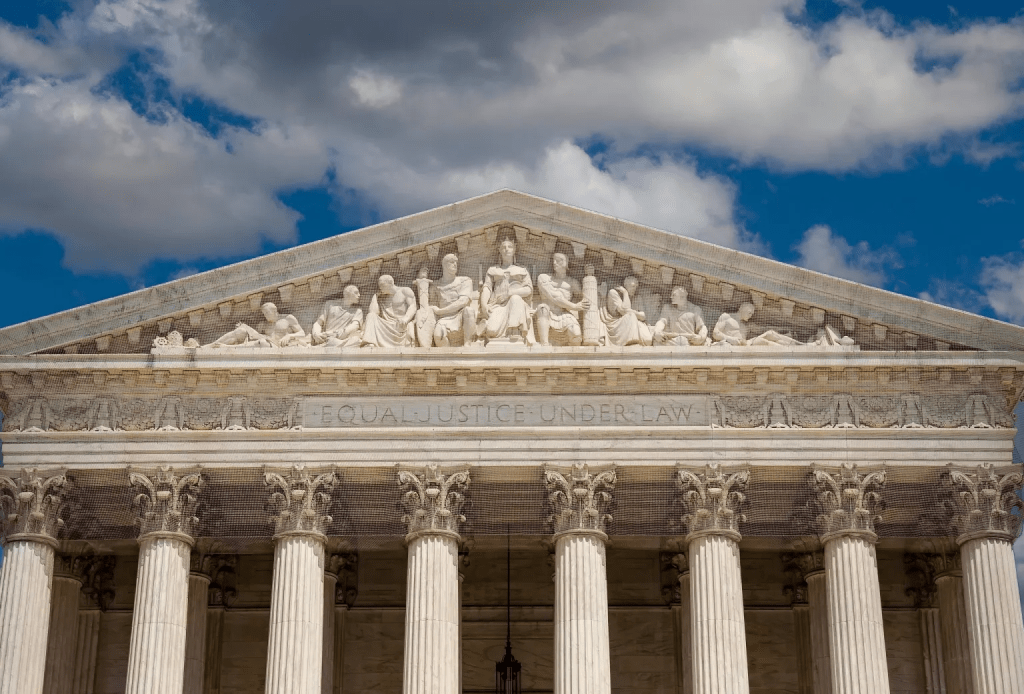
The U.S. Supreme Court’s recent unanimous decision to limit the scope of environmental review under the National Environmental Policy Act (NEPA) marks a seismic shift in how infrastructure and energy projects will be evaluated moving forward. In a ruling that clears the way for a controversial 88-mile Utah railway designed to transport crude oil, the Court redefined the boundaries of judicial and agency responsibility under environmental law — a move that carries significant implications for the future of environmental regulation, infrastructure development, and administrative deference.
⚖️ The Case: Uinta Basin Railway Project
At the heart of the case was the Uinta Basin Railway, a proposed railway extending 88 miles to connect oil-rich Utah counties with the national freight system, enabling crude oil transport to Gulf Coast refineries. The Surface Transportation Board (STB), a federal regulatory body, approved the project in 2021 after releasing a 3,600-page Environmental Impact Statement (EIS) assessing various environmental effects.
However, environmental groups and Eagle County, Colorado, challenged the STB’s approval in the D.C. Circuit Court. They argued that the agency failed to take a sufficiently “hard look” at broader environmental consequences, particularly “upstream” effects of oil drilling and “downstream” impacts from refining and burning fossil fuels transported by the railroad.
The D.C. Circuit sided with the challengers, halting the project and requiring further environmental analysis.
🧑⚖️ Supreme Court Reversal: A Procedural, Not Substantive, Mandate
In a strong rebuke to the D.C. Circuit, Justice Brett Kavanaugh, writing for the majority, stated that NEPA is “purely procedural” — it requires agencies to inform their decision-making with environmental analyses, but not to act on them in a prescriptive way.
“NEPA’s goal is to inform agency decisionmaking, not to paralyze it,” Kavanaugh wrote, emphasizing that courts must give “substantial deference” to agency determinations regarding the content of an EIS.
Kavanaugh underscored that NEPA does not prohibit a project merely because it poses environmental risks. Instead, it mandates that such risks be disclosed in a sufficiently detailed report. Once that’s done, the agency retains the discretion to weigh those risks against other policy priorities — such as economic growth or energy independence.
This effectively narrows the court’s role: Judges must ensure agencies follow procedural steps, not second-guess their policy judgments.
📚 Judicial Deference Reaffirmed
Despite the recent Loper Bright Enterprises v. Raimondo decision (where the Court limited Chevron deference — the principle that courts defer to agency interpretations of ambiguous statutes), Kavanaugh clarified that NEPA cases are different. Here, the issue is agency discretion under clear statutory authority, not statutory interpretation.
In such cases, courts review for reasonableness, not correctness. If an EIS reasonably addresses relevant environmental impacts, courts must defer to the agency’s scope and methodology — including what indirect or cumulative impacts to include or exclude.
🔍 Dissent in Agreement: Justice Sotomayor’s Concurrence
Justice Sonia Sotomayor, joined by Justices Kagan and Jackson, concurred in judgment but critiqued the majority’s over-reliance on policy rationale. She agreed the Board wasn’t obligated to block the project based on potential environmental harms from oil refining or drilling, because such activities fall outside the STB’s statutory purview.
However, she cautioned that the majority’s sweeping language could encourage underinclusive environmental reviews going forward — weakening NEPA’s practical force.
💥 Impact on Future Projects and Legal Strategy
The Court’s decision sends a strong signal that litigation is no longer an effective tool to indefinitely delay or derail infrastructure projects by challenging the scope of environmental assessments. This ruling also places more power — and responsibility — in the hands of federal agencies, reinforcing a predictable, pro-development regulatory environment.
Critics argue this will hamstring environmental protection efforts, effectively neutering NEPA’s ability to influence decision-making and facilitating projects that contribute to climate change. Advocates for infrastructure reform, on the other hand, hail the ruling as a correction of regulatory overreach that has bogged down critical projects.
Justice Kavanaugh himself noted that NEPA had “morphed into a blunt tool wielded by opponents of infrastructure,” often resulting in bloated reports and bureaucratic paralysis.
🔎 Why Justice Gorsuch Recused
Justice Neil Gorsuch recused himself, citing the Court’s newly adopted 2023 Code of Conduct. His ties to billionaire Philip Anschutz, who has energy sector investments and submitted an amicus brief in the case, likely prompted the recusal — although no specific conflict was publicly disclosed.
#EnvironmentalLaw #SCOTUSRuling #NEPA #LegalUpdate #InfrastructureLaw #AdministrativeLaw #JudicialDeference #ClimatePolicy #LawStudents #LegalInsights #OilRailwayCase #UintaBasin #JusticeKavanaugh
Source: https://www.scotusblog.com/2025/05/supreme-court-limits-scope-of-environmental-review/
 lawrota.com
Leave a comment