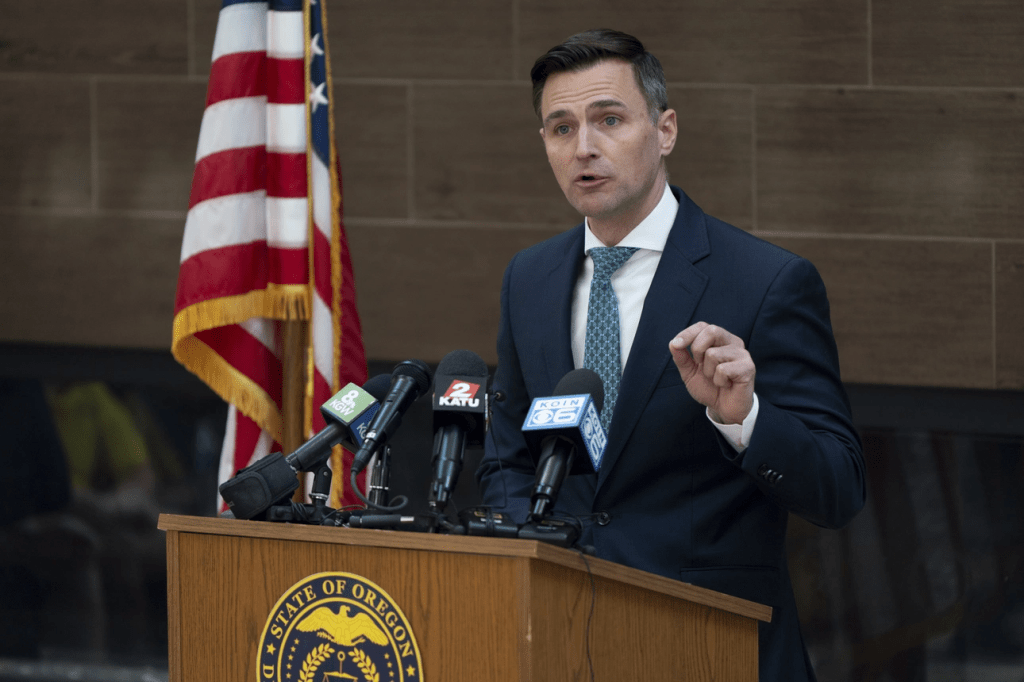
In an era where the legal system is becoming the central battlefield for America’s political disputes, Oregon Attorney General Dan Rayfield has stepped into the ring with bold resolve. Just months into his tenure, Rayfield is spearheading a 12-state coalition challenging former President Donald Trump’s sweeping tariff policies, marking one of the most consequential constitutional tests of presidential power in recent memory.
The heart of the legal challenge lies in Trump’s unprecedented invocation of the International Emergency Economic Powers Act (IEEPA)—a law enacted in 1977 to give presidents the authority to impose economic sanctions during true national emergencies. It has never been used, until now, to justify imposing tariffs. According to Rayfield and his fellow AGs, that’s not just unusual—it’s unconstitutional.
“There is no rational basis behind what the president is trying to accomplish,” Rayfield said bluntly. “This isn’t about emergency action. It’s about bypassing Congress to impose what amounts to a $3,800 tax on every American household.”
Rayfield’s legal argument is straightforward but powerful: Congress already created mechanisms for imposing trade restrictions through Title 19 of the U.S. Code. Trump used that tool properly during his first term. But now, instead of navigating congressional approval, Trump is using IEEPA as a legal backdoor—stretching presidential emergency powers beyond recognition.
California filed its own lawsuit first, but Oregon’s case is expected to be the legal spearhead, as it is anticipated to be taken up by the U.S. Court of International Trade in the coming weeks. Rayfield, in close coordination with Arizona Attorney General Kris Mayes, has built a case that could set a significant precedent not only for trade policy, but for the balance of power between the executive and legislative branches.
What prompted such swift action from Oregon? The tariffs, already in effect, are wreaking havoc on its local economy. Oregon’s small and medium businesses—many of which rely on international trade—are already feeling the squeeze. From local manufacturers to niche industries like Oregon’s massive nursery sector, the economic fallout is real. Products are being pulled from shelves in Canada. Generational trade relationships are being destroyed. All without any meaningful legislative oversight.
The business community, while largely supportive in private, remains publicly silent—caught between economic concerns and fear of political retaliation. “That is not a democracy,” Rayfield warned. “That is fundamentally a problem.”
Notably, Rayfield is no ideologue on trade policy. He acknowledges that tariffs can be a legitimate economic tool—for example, in response to steel dumping in the 1990s—but emphasizes that they must be used responsibly and within the bounds of law. In this case, he argues, the Trump administration is simply bypassing legal guardrails designed to protect both the economy and constitutional process.
In a particularly rare display of ideological alignment, even conservative legal organizations have filed similar lawsuits challenging the tariff regime. That bipartisan opposition underscores the legal overreach at the heart of Trump’s move.
Rayfield and his fellow AGs aren’t acting in a vacuum. Their coalition has become the vanguard of legal resistance against an avalanche of controversial Trump-era executive orders, from birthright citizenship crackdowns to dismantling diversity programs. While some Democratic governors have taken a more nuanced stance toward the former president, AGs have emerged as a consistent legal bulwark, united in defending constitutional norms.
Rayfield’s background as former Speaker of the Oregon House gives him a unique perspective. As a legislator, he was focused on state-level priorities like education and healthcare. Now, as AG, he finds himself on the national stage, defending the rule of law. “I would have preferred my first four months to be boring,” he admits. “But this is incredibly meaningful work.”
While Rayfield remains optimistic about their chances in court, the broader implications go far beyond trade. If Trump’s use of IEEPA is upheld, it could set a dangerous precedent—opening the floodgates for future presidents of either party to invoke “emergencies” to bypass Congress at will.
“It’s dangerous for a Democratic president to do the same things that are being done right now,” Rayfield cautioned. “That’s why you have attorneys general—to be that backstop.”
Whether or not the case reaches the Supreme Court, State of Oregon v. Trump is poised to be a landmark challenge—not just to a single policy, but to the very structure of constitutional governance in the United States.
#TradeWar #LegalResistance #ExecutiveOverreach #TariffChallenge #DanRayfield #IEEPA #TrumpTariffs #AGAlliance #RuleOfLaw #ConstitutionalCrisis #StatesVsTrump
 lawrota.com
Leave a comment