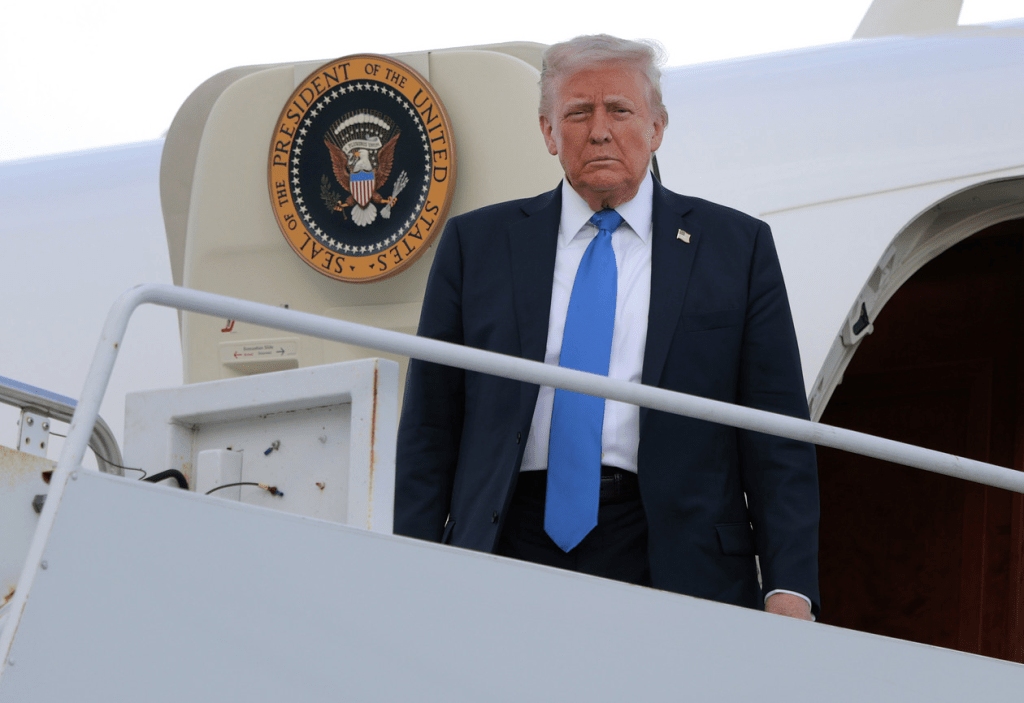
In the world of presidential perks and national defense logistics, few stories highlight the intersection of ethics, law, and public procurement like the saga of the Qatari jet offered to former U.S. President Donald Trump. What is being pitched as a “free, very expensive airplane” is, in legal and logistical terms, anything but.
Billed by Trump as a generous donation from Qatar’s royal family, the Boeing 747-8 jet once used for luxury travel is being floated as a temporary Air Force One substitute. But scratch the surface, and legal, ethical, and financial landmines emerge — making this “gift” a potential violation of U.S. law, a taxpayer burden, and a logistical nightmare.
What’s Being Offered?
The aircraft in question is a Boeing 747-8, similar in airframe to the two new VC-25Bs currently under delayed and over-budget modification for presidential use. However, that’s where the resemblance ends. According to former Air Force officials, transforming the Qatari jet into a working Air Force One would involve:
- Complete teardown of the aircraft’s interior, including wiring, avionics, and electrical systems
- Installing hardened communications, secure defense tech, and classified shielding
- Rigorous inspections to detect foreign hardware/software implants, raising significant national security red flags
Andrew Hunter, former Air Force acquisitions chief, estimates the cost of such a retrofit could run into hundreds of millions of dollars, comparable to a full VC-25A heavy maintenance cycle.
Legal and Ethical Implications: Is It Even Lawful?
While Trump has touted the move as fiscally smart, multiple legal questions arise:
- Foreign Gifts Clause: Under the Emoluments Clause of the U.S. Constitution, no federal official may accept gifts from foreign states without Congressional approval. Qatar’s offer, regardless of who holds office, would fall under statutory and constitutional scrutiny.
- Federal Acquisition Regulations (FAR): Any federal asset acquisition — particularly for something as critical as presidential airlift — must comply with competitive bidding and procurement rules. The “gift” model sidesteps these processes, raising transparency and corruption concerns.
- Presidential Aircraft Security Protocols: The jet would need to meet strict national security and survivability standards. Cutting corners to “save money” on a retrofit would violate established Department of Defense protocols, potentially endangering presidential safety.
The Real Cost of a ‘Free’ Plane
Beyond legality, the economic angle is eye-opening. According to internal Pentagon documents:
- Each VC-25B already costs $2.5 billion
- Long-term support/operation of the fleet over 30 years is expected to hit $7.7 billion
Add to that the human resource burden — skilled, high-clearance engineers and technicians would need to be diverted from the delayed VC-25B project to work on this Qatari aircraft. As Kevin Buckley, a former Air Force One program official, put it: “You’re pulling them out of the same labor pool — and a very specialized one.”
The aircraft’s original owner — the Qatari royal family — may be looking to offload it precisely because it’s too expensive to maintain.
Political and Procurement Blowback
Congressional Democrats have slammed the move as a “corrupt bargain” and a smokescreen to distract from Trump’s failure to deliver two new Air Force One aircraft. Rep. Rick Larsen noted that “unlawful foreign gifts” are not the solution to Boeing’s production delays, which have plagued the program since Trump renegotiated the contract in 2018.
Trump, for his part, called critics “world class losers” and accused them of insisting the U.S. “pay top dollar” instead of accepting a free plane. But lawmakers aren’t buying it, especially as the original $3.9 billion fixed-price contract with Boeing has already ballooned due to overruns.
This “interim solution” not only muddies the legal waters, but could further strain Boeing’s already lagging schedule, delay the delivery of legitimate replacements, and cost taxpayers more in the long run.
Bigger Picture: Setting a Dangerous Precedent?
From a legal policy perspective, accepting such foreign gifts under executive discretion — especially ones tied to defense — opens the door to undue influence, procurement evasion, and potential breaches of national security law.
If the U.S. allows foreign states to “donate” defense-grade equipment without going through Congressional oversight or formal acquisition channels, it sets a precedent that erodes the firewall between diplomacy and defense.
Conclusion: Legal Eagles Beware
For attorneys, policymakers, and watchdog groups, this case raises several red flags:
- Is a foreign government “gift” really a gift if it carries millions in taxpayer obligations?
- Can the President bypass procurement law under the guise of efficiency?
- Does such an arrangement violate ethics, national security, or both?
The Qatar jet story is more than political theater — it’s a test case in how far presidential discretion can stretch when it comes to military assets, foreign influence, and the blurred lines of public-private benefit.
In the legal skies above Air Force One, this deal may never fly.
#TrumpPlaneScandal #LegalAnalysis #DefenseLaw #AirForceOne #PresidentialEthics #ForeignGifts #QatarJet #ProcurementLaw #ConstitutionalLaw #BoeingContract
Source: https://www.politico.com/news/2025/05/12/trump-qatar-air-force-one-taxpayer-costs-00342299
 lawrota.com
Leave a comment