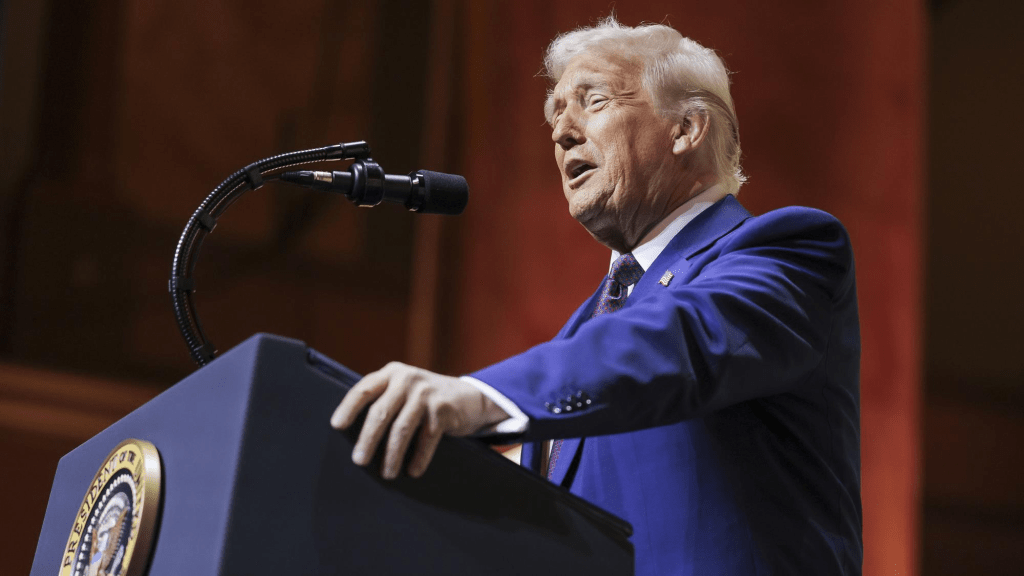
The legal profession’s definition of pro bono just shifted—and with it, a constitutional and ethical storm is brewing. Under a sweeping new executive order from former President Donald Trump, some of the nation’s most elite law firms may now be required to provide free legal defense to police officers accused of misconduct, including those involved in high-profile fatal incidents.
This development isn’t just a legal footnote—it represents a seismic redefinition of the private bar’s role in politically charged public policy.
⚖️ The Executive Order: Police Protection Through Private Counsel
On the surface, the White House’s newly released executive order—titled “Strengthening and Unleashing America’s Law Enforcement to Pursue Criminals and Protect Innocent Citizens”—is positioned as a law-and-order initiative. But buried within it lies a provocative legal mechanism: the mobilization of private-sector pro bono lawyers to defend law enforcement officers accused of crimes committed while on duty.
Specifically, the order mandates that the Attorney General “take all appropriate action” to ensure that police officers are equipped with adequate legal defense and indemnity protections. One of those “appropriate actions” is the compelled use of private-sector legal talent—free of charge.
💼 The $1 Billion Deal: Pro Bono or Political Trade-Off?
In recent months, law firms have collectively pledged over $1 billion in pro bono services to the Trump administration. Firms such as Kirkland & Ellis, Latham & Watkins, A&O Shearman, and Simpson Thacher & Bartlett are among the biggest contributors, with individual commitments reportedly exceeding $125 million.
Notably, Paul, Weiss committed $40 million over four years in exchange for relief from a Trump-era executive order threatening to cut off federal contracts over diversity and inclusion (DEI) practices.
What’s more, the original understanding was that firms would contribute to “mutually agreed upon” causes that aligned with the administration’s conservative ideals—ranging from assisting military veterans to reforming justice system inefficiencies.
But now, that flexibility seems to be fading as the executive branch directs this legal muscle toward defending law enforcement officers who may face civil or criminal liability for actions taken while in uniform.
🧨 A Legal and Ethical Flashpoint
While many law firms already provide robust pro bono support for criminal defense, immigration, civil rights, and veterans’ rights, this forced alignment with law enforcement defense—especially amid rising concerns over police brutality—raises serious red flags.
Here’s what’s at stake:
🧷 1. Autonomy & Independence of Legal Representation
The executive order introduces the possibility that the government could influence—or even mandate—who law firms represent. This challenges the core principle of legal ethics: the attorney’s duty to choose their clients independently and free from coercion.
⚠️ 2. Reputational Risk
Law firms could be compelled to defend officers accused in high-profile police brutality cases, creating PR and recruitment nightmares. This could alienate clients, associates, and communities, particularly in racially sensitive cases.
🏛️ 3. Conflict with Social Justice Goals
Many top firms pride themselves on their civil rights and DEI work. Being required to simultaneously defend officers involved in fatal shootings of unarmed civilians—disproportionately affecting Black Americans—creates a direct conflict with those stated values.
📊 By the Numbers: A Nation on Edge
- 1,173 civilians were shot and killed by police in the U.S. last year.
- 248 of those were Black, continuing a long-documented pattern of racial disparity.
- Legal defense of these officers is now being tied to mandatory pro bono assignments by elite private firms.
🔍 Is This Even Legal?
Some constitutional scholars argue that the executive branch cannot dictate legal representation from private entities, even under the guise of voluntary pro bono pledges. If challenged in court, the order could face First Amendment, Due Process, and Separation of Powers objections.
Moreover, there is no clarity on enforcement—would firms be penalized for failing to comply? Can they refuse a case based on conflict of interest, moral objection, or firm policy?
🧠 For Lawyers & Law Students: What to Watch
This situation offers a masterclass in:
- Executive overreach and legal ethics
- The weaponization of pro bono commitments
- The blurred line between voluntary service and compelled state action
- The intersection of public policy, race, and legal advocacy
Whether you’re a law student considering Big Law or a seasoned partner navigating firm strategy, this moment demands critical thought, professional courage, and legal clarity.
#LegalEthics #ProBonoPolitics #SCOTUSWatch #TrumpExecutiveOrder #PoliceDefense #LawAndOrderDebate #BigLawUnderFire #DEIvsDefense #CivilRightsLaw #LegalNews2025 #LawStudents #PoliceAccountability
 lawrota.com
Leave a comment