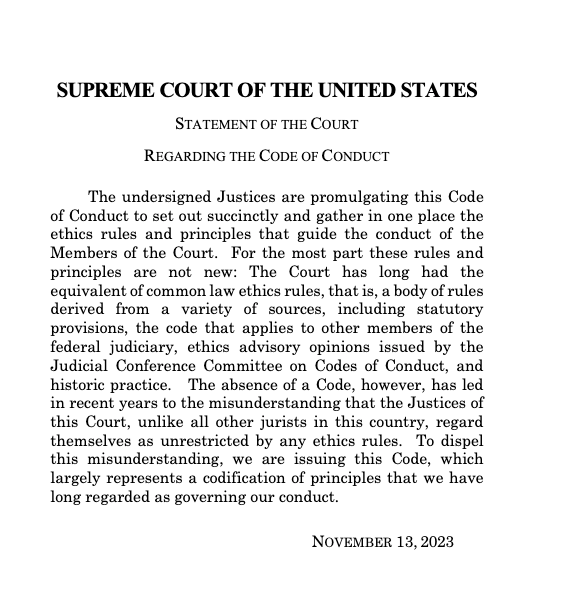
Why the Code of Conduct?
The Code of Conduct for Justices of the Supreme Court of the United States consists of three canons outlining ethical standards for justices:
LINK TO THE FILE:
https://drive.google.com/file/d/1rTnfBrlOOkT_PBQ9rY4_vjtQM179N8-w/view?usp=sharing
Canon 1: Upholding Integrity and Independence A justice should maintain high standards of conduct to preserve the integrity and independence of the federal judiciary.
Canon 2: Avoiding Impropriety
- Respect for Law: Justices should respect and comply with the law, acting in a way that promotes public confidence in judicial integrity.
- Outside Influence: Justices should not let personal, social, political, or financial relationships influence official conduct, and they should avoid lending the prestige of the judicial office for private interests.
- Nondiscriminatory Membership: Justices should not be members of organizations practicing discrimination based on race, sex, religion, or national origin.
Canon 3: Performing Duties Fairly, Impartially, and Diligently
- Responsibilities: Justices should not be swayed by partisan interests, public pressure, or fear of criticism. They should participate in assigned matters, maintain order, and behave courteously. Harassing, abusive, prejudiced, or biased behavior is prohibited. Retaliation against those reporting misconduct is not allowed.
- Ex Parte Communications: Justices should avoid ex parte communications and, if receiving unauthorized ones, notify the parties and allow them to respond. Public comments on pending matters are generally prohibited.
- Disqualification: Justices are presumed impartial but should disqualify themselves when their impartiality might reasonably be questioned. This includes instances of personal bias, prior representation in the case, financial interests, or familial relationships with parties involved.
Canon 3 (Continued): Disqualification and Financial Interests
- Government Employment: A justice should disqualify themselves if they served in government employment and participated in a previous judicial position, counsel, advisor, or material witness concerning the proceeding or expressed an opinion during prior government or judicial service on the case’s merits.
- Spouse or Relatives’ Involvement: Disqualification is required if the justice’s spouse or a person related within the third degree has served as lead counsel for a party below or is an equity partner in a law firm representing a party before the Court, unless the Court receives written assurance that income from Supreme Court litigation is permanently excluded from their compensation.
- Rule of Necessity: The rule of necessity may override the rule of disqualification in certain circumstances.
- Amicus Curiae and Financial Interests: Filing a brief as amicus curiae or participation of counsel for amicus curiae does not require a justice’s disqualification.
- Financial Interests: Justices should keep informed about their personal and fiduciary financial interests and make reasonable efforts to stay informed about the financial interests of their spouse and minor children. Disqualification is not required if the justice, spouse, or minor child divests the interest causing disqualification.
Canon 4: Extrajudicial Activities
- Permissible Extrajudicial Activities: Justices may engage in extrajudicial activities, including law-related, civic, charitable, educational, religious, social, financial, fiduciary, and government activities. They can also speak, write, lecture, and teach on law-related and nonlegal subjects.
- Limitations: Justices should avoid extrajudicial activities that detract from the dignity of their office, interfere with official duties, reflect adversely on impartiality, lead to frequent disqualification, or violate specified limitations.
Canon 4A: Law-Related Activities
- Speaking, Writing, and Teaching: Justices may engage in activities such as speaking, writing, lecturing, and teaching on law-related subjects. However, there are limitations and considerations in place to ensure these activities do not compromise the justice’s responsibilities or impartiality.
Canon 4B: Civic and Charitable Activities
- Participation in Organizations: A Justice may participate in nonprofit civic, charitable, educational, religious, or social organizations as an officer, director, trustee, or nonlegal advisor.
- Limitations: A Justice should not serve in an organization likely to engage in proceedings that would ordinarily come before the Justice or be regularly involved in adversary proceedings in any court.
- Investment Advice: A Justice should not provide investment advice to such organizations but can serve on their board of directors or trustees even if they are responsible for approving investment decisions.
Canon 4C: Fundraising
- Assisting in Fundraising: A Justice may assist in planning fundraising activities for nonprofit organizations but should not personally participate in fundraising activities, solicit funds, or use judicial office prestige for fundraising purposes.
- Use of Judicial Designation: The use of a Justice’s name, position, and judicial designation on an organization’s letterhead for fundraising is permissible if comparable information is provided for others.
Canon 4D: Financial Activities
- Investments and Remunerative Activity: A Justice may hold and manage investments, including real estate, and engage in remunerative activity but should avoid dealings that exploit the judicial position or involve frequent transactions or continuing business relationships with lawyers likely to appear before the Court or others likely to come before the Court.
- Business Involvement: A Justice may be involved in a closely held and family-controlled business, defined by family members within the third degree of relationship.
- Gifts: Compliance with restrictions on accepting gifts and prohibitions on solicitation set forth in the Judicial Conference Regulations on Gifts is required.
- Nonpublic Information: A Justice should not disclose or use nonpublic information acquired in a judicial capacity for any purpose unrelated to official duties.
Canon 4E: Fiduciary Activities
- Fiduciary Roles: A Justice may serve as an executor, administrator, trustee, guardian, or other fiduciary for a family member, subject to restrictions. The Justice should not serve if likely to be engaged in proceedings ordinarily coming before the Justice.
Canon 4F Governmental Appointments: A Justice may serve as a fiduciary for a member of the Justice’s family but is subject to restrictions, including not serving if likely to be involved in proceedings before the Court.
Canon 4G: Chamber Resources, and Staff: Justices may accept appointments to governmental committees, commissions, or positions related to the law, the legal system, or the administration of justice, provided it doesn’t undermine public confidence in the judiciary.
Canon 4H: Compensation, Reimbursement, Financial Reporting: Justices should avoid substantial use of judicial chambers, resources, or staff for activities not supporting official functions or permitted activities.
Canon 4H (continued): Justices may accept reasonable compensation and reimbursement of expenses for permitted activities, ensuring it does not appear to influence official duties. The reimbursement should be limited to actual or reasonably estimated costs of travel, food, and lodging.
Canon 5: Justices should refrain from political activity, such as holding leadership positions in political organizations, making speeches for political groups or candidates, publicly endorsing or opposing candidates, and soliciting funds for political entities. Justices should resign if becoming a candidate in an election, but this provision does not prevent participation in activities described in Canon 4.
The undersigned Members of the Court express their commitment to comply with the statute governing financial disclosure and subscribe to this Code and its accompanying Commentary. The document emphasizes the importance of maintaining public confidence in the integrity, impartiality, and independence of the judiciary.
 lawrota.com
Leave a comment